This website uses cookies

This website uses cookies to improve user experience. By using our website you consent to all cookies in accordance with our Cookie Policy.

Essential cookies enable basic functions and are necessary for the website to function properly.
Statistics cookies collect information anonymously. This information helps us to understand how our visitors use our website.
Marketing cookies are used by third parties or publishers to display personalized advertisements. They do this by tracking visitors across websites.
Jump to main content
Vertical yellow and black stripes

Force and Energy

Dauerausstellung

Force and Energy

We save energy and gather force. Or do we gather energy and save force? Can a small child lift a large adult? Can energy be created and transferred?

Balance of Forces

In this section, you’ll have to bring along some energy to build bridges, lift people, and operate a lever.

Force

When moving or changing the shape of objects, force is required to overcome natural forces like gravity. Ever since prehistoric times, people have been using tools – levers, pulleys, and other mechanical devices – to apply the necessary force to do work.

In structures like bridges and buildings, force has to be distributed so that they stay standing and withstand external pressures.
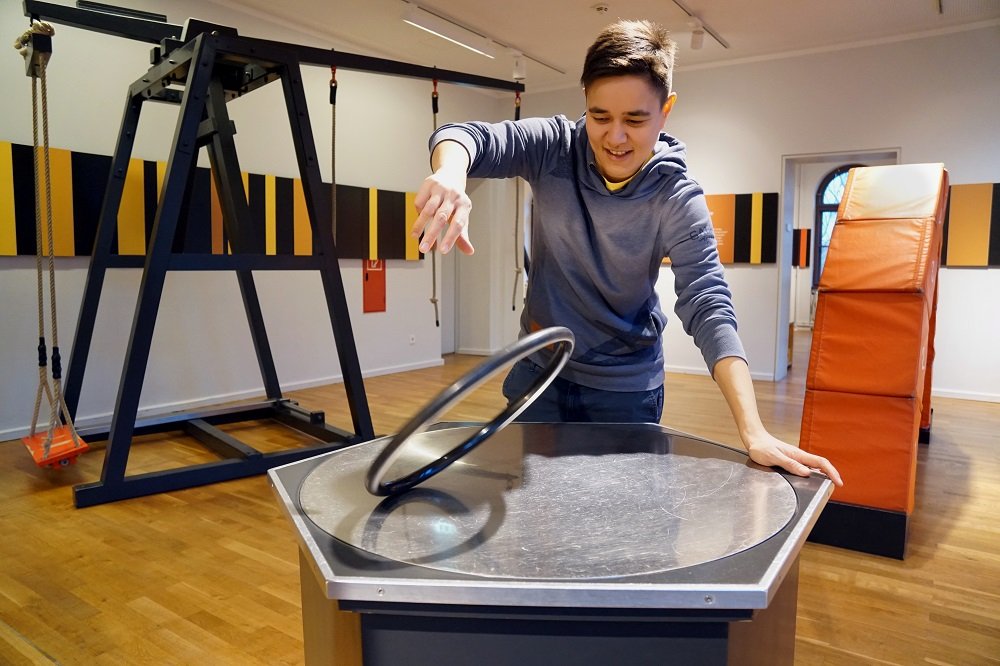
A person is leaning on a table with a metallic surface that curves slightly inward. With their free arm, they are turning a ring that is about 30 cm in diameter.
The spinning ring can be used to demonstrate various forms of energy and energy conversion processes. SDTB/ Photo: G. Hidde 1/1

Energy

Wind farms and hydroelectric plants use the power of wind and water to create energy. They do so by converting the energy present in nature into a usable form like electricity. A portion, however, is turned into heat by friction and is usually not converted back into usable energy. People require energy in all aspects of everyday life, such as for lighting, heating, and transportation. Life without energy is not possible.
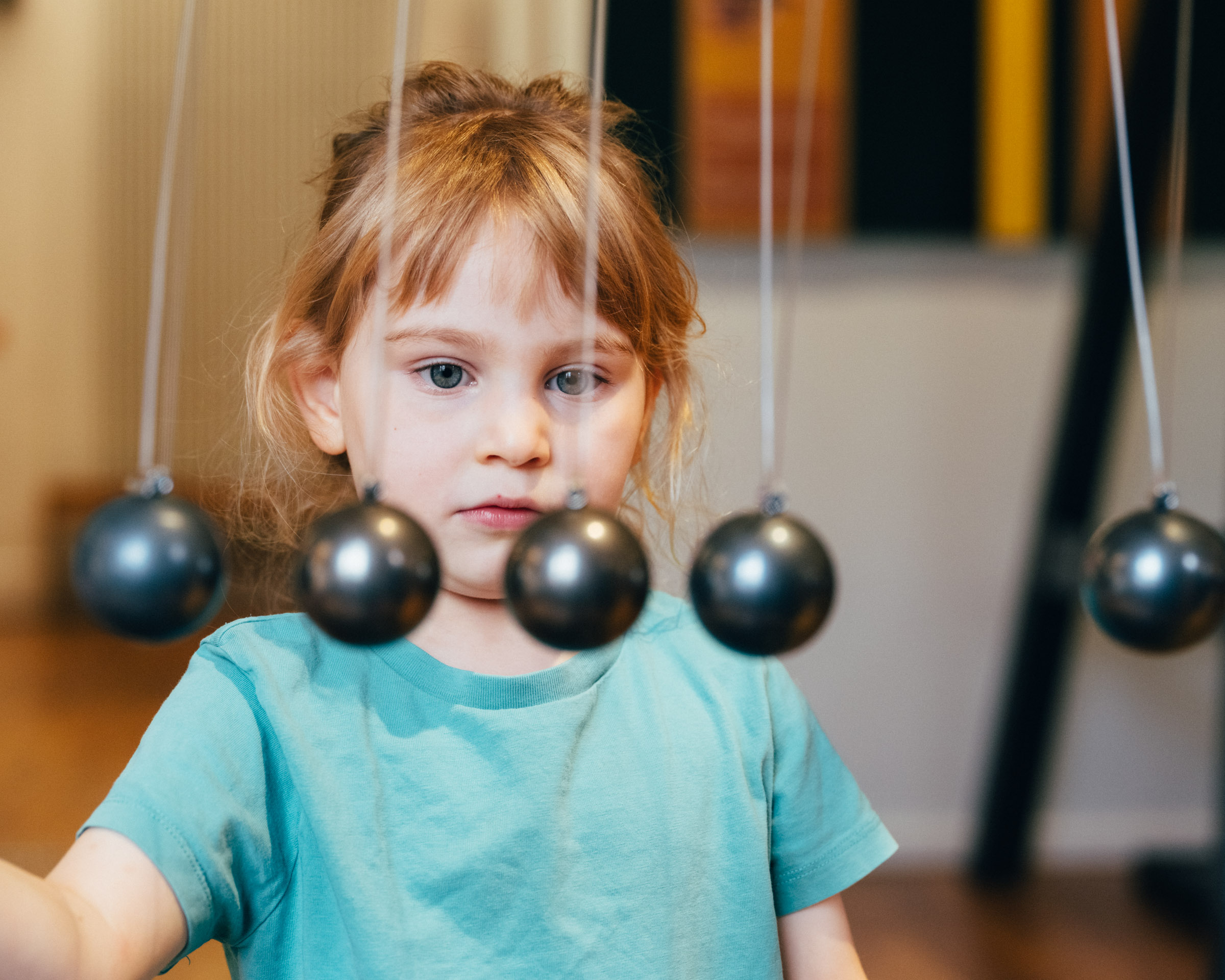
In the foreground, five identical balls—each about the size of a ping-pong ball—hang in a row, suspended by two V-shaped strings each. Behind the balls stands a girl who, to the left of the row, has just grabbed or released another ball with her hand. The girl is looking intently at the balls.
The Newton's cradle impressively demonstrates the conservation of momentum and energy. SDTB/ Photo: Ériver Hijano 1/1